
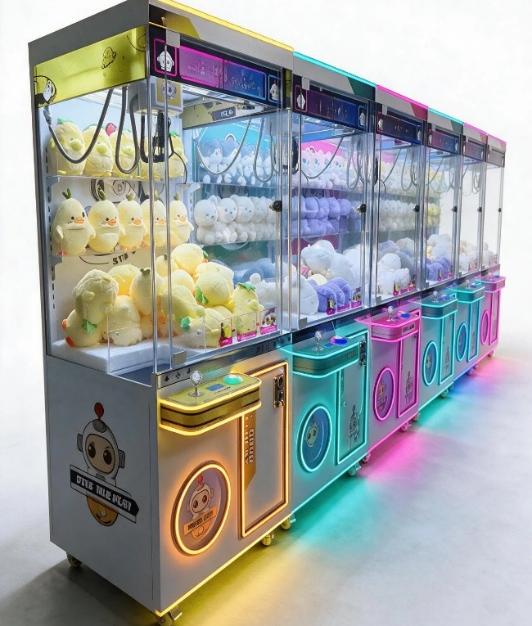
Claw Crane Prize Cost: Building a Prize Mix That Makes Money
A claw crane is not a game of skill. The player pays a fixed price for a chance at a prize, and the operator decides whether that chance is profitable by controlling two things: the claw strength and the cost of the prizes inside the cabinet.
Get either one wrong and the machine looks busy while earning nothing. Get both right and a bank of cranes can carry the margin for an entire floor.
This guide covers how to calculate the real landed cost of a prize, how to structure prize tiers so the claw cannot reach the expensive ones, and how to price the mix against your coin value.
Start with landed cost, not catalogue price
The number most operators get wrong is the prize cost itself. A plush that costs 3.20 USD on a supplier's price list does not cost 3.20 USD in your cabinet.
Landed cost = unit price + packaging + inbound freight + duty + wastage
| Component | Typical share of catalogue price | Notes |
|---|---|---|
| Unit price | 100% (baseline) | Bulk pricing usually starts around 500-1,000 pieces |
| Packaging | 3 - 8% | Bins and cartons also count as waste if damaged |
| Inbound freight | 5 - 15% | Depends on origin, mode and container consolidation |
| Duty and tax | 0 - 12% | Check your local tariff classification for plush toys |
| Wastage and breakage | 3 - 8% | Damaged stock, seasonal leftovers, unsold prizes |
Worked example on a 3.20 USD plush bought in a 500-piece order:
- Unit price: 3.20 USD
- Packaging: 0.16 USD
- Inbound freight and duty: 0.42 USD
- Wastage allowance at 6%: 0.23 USD
- Landed cost: 4.01 USD
That 25% gap between catalogue price and landed cost is the difference between a profitable crane and a loss-maker.
Set prize tiers against your coin value
Prize tiers exist so that the claw's natural preference works in your favour. The claw grabs whatever it can most easily reach. Your job is to make sure that whatever it reaches is the prize you can afford to lose.
The standard three-tier structure:
| Tier | Typical landed cost | Share of prize volume | Position in cabinet |
|---|---|---|---|
| Tier 1 - common | 0.40 - 1.20 USD | 60 - 70% | Top layer, fully visible |
| Tier 2 - mid | 1.20 - 3.00 USD | 25 - 30% | Middle, partially covered |
| Tier 3 - premium | 3.00 - 8.00 USD | 5 - 10% | Bottom, at the back |
Two rules make this work:
- Put the mid-value prizes on top. If the top layer is your most expensive stock, the claw wins on your most expensive stock every time.
- Keep tier 1 prizes small enough that the claw grabs them reliably. A large prize that the claw keeps knocking over teaches players the machine does not work.
- Average landed prize cost across the mix: 1.60 USD
- Probability of winning: 25%
- Expected prize cost per play: 0.40 USD
- Gross margin per play: 1.60 USD, or 80%
- Expected prize cost per play: 0.20 USD
- Gross margin per play: 1.80 USD, or 90%
- 60 x 30 = 1,800 plays per month
- 1,800 x 0.25 = 450 prizes consumed per month
- At an average landed cost of 1.60 USD, that is 720 USD of prize stock per machine per month
- Weigh a sample. Take ten prizes, weigh them, compare to the supplier spec. Volume differences between suppliers are common and they directly affect how many fit per cabinet.
- Test one claw setting for a week. Log every play. If the claimed win rate and your measured rate differ by more than a third, the claw needs adjustment before the machine is anywhere near your floor.
- Confirm cabinet volume with your actual prize. A cabinet rated for 150 mid-size plush may hold only 90 if your supplier's plush is bulkier. Ask for the packed carton dimensions.
- Check the prize appeal against your audience. In a family centre, characters and bright colours sell. In a mall unit aimed at teenagers, licensed or branded items do. Wrong prizes at the right price still lose money because nobody plays twice.
- Separate the tiers physically. Use dividers or trays. Mixed loose stock means the claw finds the expensive prize by accident.
- Price your prize tiers consistently across the whole bank. Players notice when one crane gives away a 6.00 USD plush and the next one gives a 0.60 USD one. It costs you plays.
- Upfront machine spend: 6 x 2,400 USD = 14,400 USD
- Upfront prize stock: 6 x 120 prizes x 1.60 USD = 1,152 USD
- Monthly gross margin: 6 x 3,024 USD = 18,144 USD
- Prize restock per month: 6 x 576 USD = 3,456 USD
- Negotiate prize pricing on volume, not per-unit. Ask for the tiered price at 1,000, 3,000 and 5,000 pieces. The gap between tiers is often 15 to 25%, and it applies to every prize you will ever buy.
- Keep the prize budget in your cash-flow forecast, not just the equipment budget. Model it monthly. A venue that models the machines but not the prizes will run short of working capital in month two.
- What is the claw adjustment range on this model, and can the operator change it without tools?
- What is the rated prize capacity, and at what plush size?
- Is the prize volume shown in the machine, or separate from the machine, or both?
- What spare parts are stocked for export, and what is the typical lead time on a replacement claw, coin acceptor and control board?
Price the mix against your coin value
The margin calculation comes down to expected cost per play.
Expected prize cost per play = (landed prize cost) x (probability of winning)
Worked example with a 2.00 USD play and a 1 in 4 win rate:
Now change the win rate to 1 in 8 and hold the prize mix constant:
The margin per play looks better. But total revenue falls, because a player who loses seven times in a row usually walks away. This is the single most misunderstood point in claw crane economics, and it is covered in detail in our claw crane payback guide.
The practical target: for most venues, a win rate between 1 in 4 and 1 in 6 is the working range. Below 1 in 8, repeat play collapses. Above 1 in 3, the margin gets thin fast on any prize above 2.00 USD.
Calculate restock volume from play volume
Once you know your win rate, prize restock volume follows directly.
Prizes consumed per month = (plays per machine per day) x (win rate) x (operating days)
Take a crane doing 60 plays per day, 30 days a month, at a 1 in 4 win rate:
Now check that against the cabinet's actual volume. A full-size cabinet such as our W78 x D85 x H190 cm crane machine holds roughly 120 to 160 plush depending on plush size. At 450 prizes consumed per month, you are restocking the cabinet roughly three to four times per month. That is the number that tells you how much cash to leave in the prize budget and how often your delivery schedule has to run.
Six checks before you stock a crane
Work the numbers for a full bank of cranes
Single-machine maths rarely convinces a bank. Here is how the same model scales across a floor.
Take our W78 x D85 x H190 cm full-size crane machine as the unit, with a landed machine cost of 2,400 USD, a 2.00 USD play, a 1 in 5 win rate and an average landed prize cost of 1.60 USD.
Per machine, per month (30 operating days, 60 plays a day):
| Line | Calculation | Result |
|---|---|---|
| Plays per month | 60 x 30 | 1,800 |
| Wins per month | 1,800 / 5 | 360 |
| Prize cost per month | 360 x 1.60 USD | 576 USD |
| Gross revenue per month | 1,800 x 2.00 USD | 3,600 USD |
| Gross margin per month | 3,600 - 576 | 3,024 USD (84%) |
For a bank of six machines on the same floor:
The number most operators miss is that prize restock, not machine purchase, is the recurring cash drain. 3,456 USD a month leaves the venue before rent and labour do. A bank of cranes that looks cheap on the equipment line can consume more working capital in prize stock than the machines cost.
Two practical consequences follow:
What to ask your supplier
Ask specifically:
One question is worth asking first because it changes everything downstream: does the supplier quote the machine on its own, or as a package with an initial prize kit? A package price with a starter prize load looks higher on the quotation but removes the single largest hidden cost from the project. A machine-only price leaves you sourcing prizes separately, which usually costs more once freight and duty land.
Our claw and crane machine range covers countertop mini units from W30 x D45 x H84 cm through 4-player and twin full-size cabinets, all CE certified for the European market.
Getting a real quote
Tell us the models you are considering, your target prize value per play, your coin value and your destination country and port. We will confirm machine pricing, MOQ and the delivery schedule in the quotation. Standard production lead time is 5-25 days for all models.
Tell us your venue type, floor area, target market and quantity, and our export team will propose a machine mix with confirmed pricing, MOQ and delivery timing.