
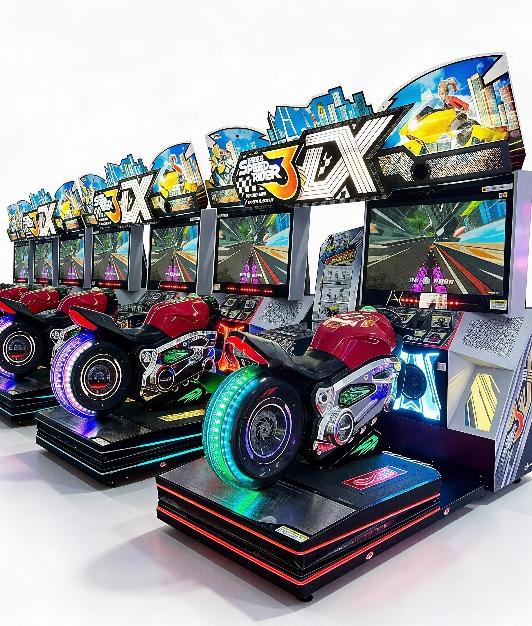
Arcade Racing Simulator Buying Guide: How to Choose
An arcade simulator is the most expensive machine you will put on a floor and the one that generates the highest revenue per square metre in the venue. It is also the one that most often disappoints, and the disappointment nearly always comes from the purchase, not the machine.
The reasons are consistent: the cabinet was chosen for screen size rather than revenue profile, it was installed where there is no overhead clearance, or it was bought with no plan for what plays on it.
This guide walks through the four simulator families and how each earns, how motion changes the commercial calculation, how to size a mix against real floor area, and what to confirm with your supplier before you pay for the container.
Start with the game type, not the cabinet
Simulators are not one category with three sizes. They are four different businesses that happen to sit in the same aisle.
| Game type | What the player buys | Revenue characteristic |
|---|---|---|
| Moto and car racing, motion platform | Physical movement in the game | Highest revenue per play, longest session, highest cost |
| Moto and car racing, non-motion | Screen and seat only | Strong revenue, lower cost, shorter session, smaller footprint |
| Gun and shooting simulators | Skill and spectacle with a physical gun | Broad appeal, repeat-play friendly, lower play price |
| Classic upright cabinets, 32-inch | Familiar titles, short skill curve | Lowest revenue per m² and capital cost, fast turnover |
Two observations from the trade worth building your plan around.
Motion is a bigger commitment than it looks. A motion platform adds a mechanical system that wears, needs levelling and clearance around and behind it. What you gain in session length and play price you give back in floor area and service time.
Classic upright cabinets are the fastest capital recovery machine in the range. They cost a fraction of a motion rig, fit almost anywhere, and need no floor box or overhead work. A mall unit on a tight budget is often better served by a bank of uprights and one motion hero machine than three rigs.
Motion versus non-motion
| Factor | Motion simulator | Non-motion cabinet |
|---|---|---|
| Floor area per unit | 8-12m² with player clearance | 1.5-3m² |
| Play price you can charge | Higher | Lower |
| Average session | 3-5 minutes | 1.5-3 minutes |
| Turnover rate per hour | Lower, the session is long | Higher |
| Revenue per square metre | Highest | Moderate |
| Mechanical maintenance | Motors, pneumatics, bearings | Almost none |
| Floor and ceiling needs | Level floor, rear and overhead clearance, often a floor box | Floor level only |
| Transport | Crated, heavy, needs a proper unload | Ships as a finished cabinet |
The turnover point is where simulator buying goes wrong. A motion machine earns more per session but serves fewer sessions per hour. Whether it wins depends entirely on floor area. If you have space for eight motion rigs, buy eight. If you have space for two, buy two and fill the rest with faster-turning cabinets.
Single seat versus two, four and six positions
The seat count changes the revenue arithmetic in a way that is not linear.
| Configuration | Revenue per session | Players per hour | Queueing effect | Best use |
|---|---|---|---|---|
| Single seat | Lowest | Highest | No queue, instant turnover | Classic uprights, single racers |
| Two seats | Double a single seat | Medium | Players wait on spec, groups arrive together | Air hockey, two-player skill games |
| Three to four seats | Highest | Lowest | Persistent queue, needs a 2.5-3m lane | Motion hero machines, dance stations |
| Five to six seats | Highest, slowest turnover | Lowest | Queue becomes the attraction | Kiddie rides, large motion platforms |
The trap in multi-player is assuming more seats means more money. A four-player machine serving one group every four minutes earns less per square metre than a single-seat cabinet serving four separate players in the same time, unless the four also buy tokens, food or prize items. Multi-player earns through the venue, not the cabinet. With no secondary spend, favour single-seat positions.
Power draw and cooling: use the real numbers
We publish a rated power figure for every model where one applies. Across the 139 rated models the median is 350W and the average 329W.
| Rated power | Models | Share | What sits in this band |
|---|---|---|---|
| 350W | 38 | 27.3% | The core of the redemption line |
| 400W | 18 | 12.9% | The commonest simulator rating, most moto cabinets |
| 200W | 14 | 10.1% | Redemption games, hockey tables, compact cabinets |
| 100W | 11 | 7.9% | Basketball, boxing and kids units |
| 150W | 10 | 7.2% | Boxing and sports skill cabinets |
| 500W | 9 | 6.5% | Large motion and gun simulators |
| 300W | 8 | 5.8% | Upright cabinets, dance and road racers |
| 800W | 4 | 2.9% | Large motion gun and pirate sims |
| 600W | 4 | 2.9% | Dance stations, Happy Castle cabinet |
| 1000W | 2 | 1.4% | Dynamic Moto 3 DX and 5 DX platforms |
By category, the averages are more useful for planning than any single model figure:
| Category | Models rated | Average | Range |
|---|---|---|---|
| Arcade video games and simulators | 44 | 482W | 250-1000W |
| Redemption and ticket games | 58 | 322W | 125-650W |
| Sports and skill games | 34 | 132W | 40-200W |
| Claw and crane machines | 2 | 395W | 340-560W |
| Prize machines and merchandisers | 1 | 600W | 600W |
Three practical points follow.
A motion platform is roughly three times the load of a standard cabinet. The Dynamic Moto 3 DX and Dynamic Moto 5 DX are the two heaviest models we manufacture, at 1000W each. A non-motion moto cabinet such as the Moto DX sits at 400W. That difference shows up in your electricity bill and, more importantly, in the circuit you need.
Heat is a design constraint, not a comfort issue. A 400W cabinet converts essentially all of that to heat. In a 12-14m² room with eight machines running you face around 3kW of continuous heat to remove, and a sealed cabinet in a corner with no rear clearance will cook its own power supply. Specify at least 20cm rear and 10cm side clearance per simulator.
Distribution matters more than the total. The 350W band dominates because it is the redemption line, and redemption cabinets are the ones packed in rows. Plan at least two machines per 13A socket on 220V, and never put two 1000W platforms on the same circuit as a row of redemption games.
Sizing a machine mix against floor area
This is the decision table to work from, assuming standard 1.5 m player clearance and 0.8 m service access.
| Floor area | Recommended simulator allocation | Revenue per m² | Notes |
|---|---|---|---|
| Under 40m² | 1 motion hero unit, rest single and two-player cabinets | Low to moderate | One strong machine carries the venue, do not attempt two platforms |
| 40-100m² | 2-3 motion units, plus uprights and a two-player area | Moderate to high | The commonest standalone footprint, aim for 25-35 machines |
| 100-250m² | 4-6 motion units, plus dedicated redemption and skills floors | High | Enough rotation to keep platforms busy without a permanent queue |
| Over 250m² | 6+ motion units, split into themed zones | Highest | Split by family so groups self-select |
Two rules survive every floor size. Put the motion units at the two ends of the walking route rather than the middle, so a visitor sees a platform before deciding to enter. And keep the entrance sightline on the strongest visual you own, usually a lit platform or crane bank rather than an upright cabinet.
Our arcade video games and simulator range covers 58 models, from 32-inch wooden-cabinet uprights through the 400W moto cabinets to the 1000W Dynamic Moto platforms. The sports and skill game range covers 45 models of hockey tables, basketball, boxing and interactive sports units, which average 132W and fit far smaller spaces.
The single-player classic cabinet in a mall
The 32-inch classic format in our catalogue, from VTRA018 through VTRA021, is frequently underestimated.
A cabinet such as the 32-inch Street Fighter IV (VTRA018) or the 32-inch Street Fighter VI (VTRA021) measures roughly 82-93cm wide and 150-168cm tall. Against a motion platform at 230cm wide, 280cm deep and 250cm tall, it is a third of the footprint, a quarter of the power and a fraction of the cost.
In a large mall it performs best as a filler and attractor: a row of uprights along a window wall or mall corridor draws people in through the sightline at almost no floor cost, and the visitor then walks in and meets the motion unit. On its own as the main attraction in a large unit, it underperforms badly, producing no queue, no spectacle and no reason to stay.
The other advantage is content. Upright cabinets are where licensed and recognisable titles live, and where players know the games, a familiar title sells more plays than a technically superior unfamiliar one.
Mistakes that cost operators the most
Buying the machine before the floor plan. A 250cm platform in a room with a 235cm ceiling is a written-off machine. Measure ceiling height, door width, turning radius and the distance from the lift to the machine position before releasing the order.
Ignoring the power position. A row of ten cabinets needing 10 sockets cannot share two wall points with extension leads across a walkway. This is a trip hazard, it fails inspection in most markets, and it is why many machines arrive and sit unplugged. Specify every socket position on the layout.
Buying hardware with no content plan. This quietly costs the most. The cabinet is only the box. Ask what runs on it, how many titles are included, how many players play simultaneously, whether the list can be updated, who provides the updates, and what support applies after warranty. A simulator with three titles and no update path earns nothing after month four.
Treating the platform as an isolated unit. A motion rig needs a clear approach lane of at least 2.5m for the queue, rear clearance for the technician and level floor. Placed against a wall with a railing behind it, it works mechanically and fails commercially.
Before you issue the purchase order
Confirm these in writing, per model:
- Exact machine dimensions, including the platform at full travel extension.
- Rated power per machine and the recommended number of units per circuit.
- Voltage, frequency and plug type for your destination market.
- Weight and floor loading for the position, particularly for motion platforms and kiddie rides.
- Ceiling and overhead clearance required, in writing.
- Content and update terms: titles, update mechanism, support period.
- Certification for your destination market. CE marking covers the European Economic Area; other markets have their own requirements.
- Spare parts availability and the unit cost of what actually fails: coin acceptors, touchscreens, power supplies, motion motors, harnesses.
- Shipping dimensions and loaded container plan, since this sets landed cost per unit.
- Payment terms and lead time. Standard production lead time is 5-25 days for all models.
Talking to a supplier
The most productive way to start is a short specification: floor area, ceiling height, budget band, target audience, daily footfall, destination port and country, and the site voltage and frequency. From that, a capable supplier will propose a mix and be straight about which models earn in your location.
We manufacture arcade and amusement equipment directly, have done so for over 21 years and export to more than 150 countries. Tell us the venue details and our export team will match models to the space and confirm pricing, MOQ and delivery in the quotation.
Tell us your venue type, floor area, target market and quantity, and our export team will propose a machine mix with confirmed pricing, MOQ and delivery timing.