
Claw Crane Economics: Realistic Payback Periods and Cost per Play
Claw cranes look like the simplest machine in the venue to understand: the player drops a coin, moves the claw, grabs a prize. But the economics behind that simplicity are frequently misjudged, and operators who treat claw cranes as "just one more coin-op" often end up with a bank of machines that look busy and earn very little.
This guide covers what a claw crane actually costs to run, how to calculate your real cost per play, and the single machine setting that determines whether the unit is profitable.
The revenue model: a claw crane is a margin business
A claw crane does not earn on skill. The player pays a fixed coin value for a chance at a prize, and the operator controls the margin by controlling two variables: the claw strength and the prize cost.
The formula is simple:
Revenue per play = coin value
Cost per play = (prize cost × probability of winning) + (cost of the play itself)
That second term is where most operators get it wrong. If the claw is set so that a player wins roughly one attempt in three, and the average prize costs you 35% of the coin value, then your cost per play is around 12% of coin value, leaving roughly 88% as gross margin before electricity, rent and labour.
The same machine with a claw set to win one time in eight produces a cost per play of about 4.4% of coin value - much better margin per play, but far fewer plays, because a losing player walks away rather than feeding in another coin.
The optimal setting depends entirely on the venue. In a family entertainment centre with a strong prize counter and plenty of passing traffic, a moderately generous claw encourages repeat play. In a mall corridor with transient footfall, a tighter claw is better, because your volume comes from strangers who will only try once.
How to calculate your actual cost per play
The theoretical claw strength is only half the picture. You need to measure what actually happens on your floor.
- Log every 20 plays. Record wins and losses by prize type. This takes about 20 minutes per machine per day and is the only reliable way to know your real win rate.
- Weigh your prizes. Purchase price divided by what the machine dispenses is your true unit cost. Include the plush, the packaging and the freight - not the catalogue price.
- Separate prize tiers. A crane carrying one 4 USD plush and one 0.60 USD plush will have very different cost per play depending on which one the claw tends to grab. Keep tiers physically separated and note the mix.
- Account for the empty machine. When prizes are low, the claw grabs air. Your effective win rate drops, and so does revenue. Budget for a regular restock schedule.
- Best case, 12-14 months - prime mall or supermarket position, high footfall, generous claw, well-stocked with mid-value prizes that customers want.
- Typical case, 16-20 months - solid venue position, moderate traffic, claw tuned to the venue.
- Slow case, 24 months and beyond - low-traffic corner, prizes that are not appealing, or a claw so tight that nobody plays twice.
- Month 1 - Install two or three units in candidate positions with a modest, popular prize mix. Treat them as a test.
- Month 2 - Log every play. Compare the two candidate positions directly. One will be meaningfully better than the other.
- Month 3 - Relocate or retire the underperformer, restock the winner with a better prize mix, and buy additional units for the position that proved out.
What a claw crane actually costs you
The capital cost is only the starting point. Here is the full picture for a mid-size cabinet.
| Cost item | Typical range | Notes |
|---|---|---|
| Machine purchase | 1,600 - 3,200 USD per unit | Varies with cabinet size, lighting and glass |
| Freight and insurance | 6 - 12% of machine value | Depends on destination port and Incoterm |
| Initial prize stock | 400 - 900 USD per unit | Frequently the biggest surprise for first-time operators |
| Local installation | 50 - 150 USD per unit | Power, position, level adjustment |
| Electricity | Very low | A crane is mostly glass, steel and a small motor |
| Maintenance parts | 5 - 8% of machine value per year | Claw, cables, coin acceptor, board |
The line that surprises first-time operators is the initial prize stock. A crane cannot run without prizes, and a crane with a thin prize layer plays badly and looks uninviting. Plan to stock each machine properly from day one.
Payback period: what to expect
With realistic numbers - a mid-priced cabinet, a 2 USD play value, 8 to 10 plays per machine per hour at good traffic, and a 65 to 75% gross margin on plays - a well-placed claw crane typically pays back its landed cost in 14 to 22 months.
Where the range comes from:
If your business plan assumes a 6-month payback on claw cranes, the model is wrong. If it assumes 18 to 24 months with a plan to relocate underperformers after six months, the model is realistic.
The setting that matters more than the machine
There is a persistent belief that buying a more expensive cabinet produces better results. In practice, three variables decide whether a claw crane makes money, and only one of them is the hardware.
1. Placement. A crane at the entrance, beside a prize counter or next to a kiddie ride area will outperform an identical crane in a back corner, often by a factor of three or more. Floor position is the single highest-leverage decision.
2. Prize appeal and layering. The claw grabs the easiest prize it can reach. If the top layer is your most expensive plush, you will lose money on every win. Put the mid-value prizes on top and the premium ones underneath.
3. Claw strength. Tune it to the venue, then re-tune it monthly based on your play log. A claw that is slightly too strong in a high-traffic mall drains margin; one that is too tight kills repeat play.
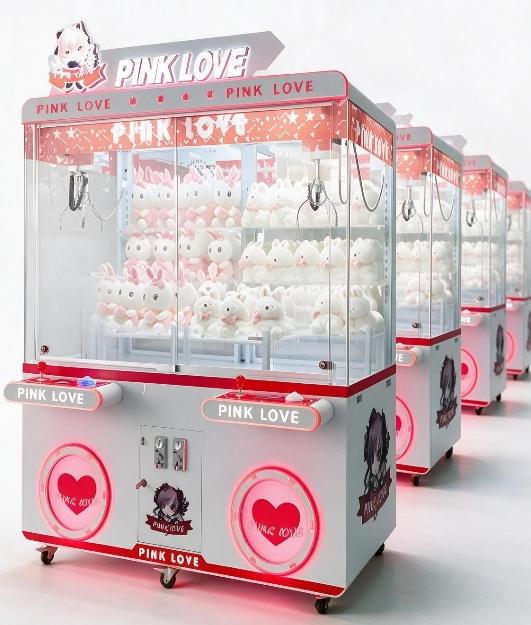
The machine itself matters mainly in two ways: durability in a commercial setting, and how visible and attractive the cabinet is from a distance. Our claw crane range covers countertop mini units for low-footfall spaces up to four-player and twin-cabinets for high-traffic mall positions, with CE certification for the European market.
A practical first-quarter plan
If you are adding claw cranes to an existing venue rather than opening from scratch, a staged approach tends to work better than buying everything at once.
By month three you will have a cost per play figure based on your actual venue rather than a generic assumption, and you will know your payback period before you have committed the rest of the budget.
What to ask a supplier
Ask specifically: what is the claw adjustment range on this model, is it tool-free for the operator, what prize volume does the cabinet hold, and what spare parts are stocked for export. These four answers determine whether you can run the machine economically in your market.
We manufacture claw cranes as part of a broader amusement equipment range and have exported to more than 150 countries over 21 years. Send us your floor plan and target market and we will recommend the cabinet format and quantity that fits the traffic pattern, with pricing and delivery confirmed in the quotation.
Discuss your claw crane requirements or see the full crane range.
Tell us your venue type, floor area, target market and quantity, and our export team will propose a machine mix with confirmed pricing, MOQ and delivery timing.