
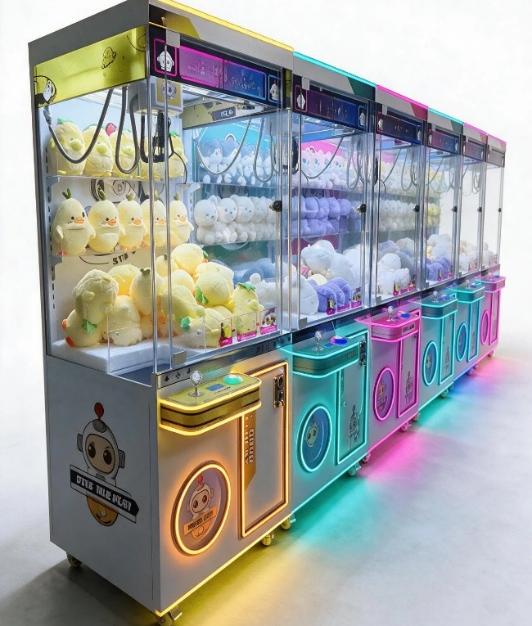
Claw Crane Claw Strength Tuning: A Practical Guide
The claw strength setting is the only number on a claw crane that decides whether it earns money. The cabinet, the lighting and the glass make a visitor stop. The claw decides whether that visitor walks away with a plush worth 0.40 USD or walks away empty-handed and never comes back.
Operators routinely set the claw once, on day one, with whatever setting the machine shipped with, and never touch it again. That is the most common reason a crane bank underperforms in a venue it should carry.
This guide covers what controls grip, how to test changes without guessing, and how to match a setting to your venue.
Why the claw setting is the profit setting
Every play has the same structure: the player pays a fixed coin value, the claw does one thing, and the prize cost lands on your ledger only if the claw succeeds. Your expected cost per play is:
Expected prize cost per play = (average landed prize cost) x (measured win rate)
Nothing in that equation changes when you replace the cabinet with a more expensive one. The win rate does, and the claw sets it. That is why claw strength tuning is not a maintenance chore: it is the operating parameter you review weekly, alongside the play log and restock list. The claw crane prize cost breakdown covers how to price the prizes once the claw is behaving.
The three variables that decide whether a claw grabs
Grip is not one setting. It is the outcome of three interacting variables, and the commonest mistake is changing two at once without knowing which one did the work.
| Variable | What it controls | What you can change |
|---|---|---|
| Current and force setting | Peak grip force before the claw slips | The operating setting, in steps |
| Claw finger geometry and material | Contact area, purchase angle | Finger count, width, curvature, tip material |
| Prize physical characteristics | What the claw can hold | Prize selection, packing density, orientation |
Current and force setting
The claw is driven by a small motor, and the board applies power to it for a set period. The closing force is a function of the current that motor draws, so a higher setting means more torque and more lifting capability.
Two consequences follow. Too strong and you pay for wins you did not need, because expected prize cost per play rises with the win rate. Too weak and you lose the repeat player, and since revenue comes from plays rather than wins, losing plays is worse than losing margin. Most cranes let the operator step the setting through a range, and what that range represents numerically differs between manufacturers, so calibrate against measured win rate, not a label.
Claw finger shape and material
The fingers determine how much surface the claw gets onto the prize and how far the grip extends around it.
- Finger count. More fingers spread the contact area wider, which helps with bulky prizes, but each has less travel. Fewer concentrate force, which helps with small or slippery items.
- Finger width and curvature. A wide flat finger gets a large contact patch on a flat-sided prize and almost nothing on a round one. A tapered finger reaches around a cylinder.
- Surface material. Bare polished steel grips smooth plastic well and fabric poorly. Rubber-coated pads improve grip on plush and cloth but cost you pressure on hard items.
- Magnet-assisted claws suit a prize mix dominated by small metal items. They are a different machine, not a different setting, and they change your prize selection rules.
This variable is often the one that needs to change. When you swap a prize supplier and the win rate collapses, the claw is usually fine and the prizes are different.
Prize physics
Two prizes of identical value can behave completely differently.
- Fluffy plush compresses around the fingers, so the claw closes with far less hard contact than it appears to. It often lifts well because the fibres fill the gaps, but can also squeeze out of a partly closed claw.
- Hard, smooth, cylindrical items give a small, slippery contact patch and are among the hardest to pick up.
- Light items need enough friction not to slide out, so they punish a claw that closes too fast.
- Top-heavy items rotate out of a partial grip.
The tuning loop: one change at a time
This is the method that works. It is slow for the first two sessions and then it becomes routine.
- Measure the current win rate. Play 50 attempts and log each result: prize won, prize missed, and the setting in force. Do this before touching anything.
- Decide the target win rate and write down why. A target without a reason gets changed every time a bad day happens. The typical working range is 1 in 4 to 1 in 6 for most venues, with the reasoning in our claw crane economics guide.
- Change exactly one variable. If you are adjusting the force setting, do not also restock the cabinet in the same session.
- Run 20 to 30 plays at the new setting. Fewer than 20 and the result is noise. More than 30 and you burn trading time.
- Log the new win rate and the prize mix during the test. A rate measured over a full cabinet of bulky plush is not comparable to one over an empty cabinet.
- Keep the setting that moves you toward the target. Re-test once to confirm before you commit.
- Write the accepted setting on the cabinet. Label the inside of the door with the date, setting and measured rate. Two operators working the same bank at different settings is an invisible way to lose margin.
- Measure the win rate over 50 plays and record it against the setting.
- Confirm the setting is labelled on the cabinet, with a date.
- Check the fill level and re-arrange prizes by hand, largest grippables on top.
- Check the fingers for wear, bend and pad condition.
- Confirm the prize mix matches the setting. A claw set for mid-value plush does not suit a cabinet of hard cylinders.
- Check the mechanical alignment: the claw should descend straight and close symmetrically.
- Log the first week of real plays and compare against your baseline. A large gap usually means the prize mix, not the claw.
- What is the claw adjustment range, in what units, and can the operator change it without tools?
- Is the setting a physical dial, a menu option on the control board, or a jumper, and does changing it require opening the cabinet?
- What claw finger options are available, and are spare fingers and friction pads stocked for export?
- What is the lead time on a replacement claw, claw board, coin acceptor and power supply?
- Does the configuration arrive set up for the target market's voltage and frequency, and can it be reconfigured?
Repeat the loop monthly, and always immediately after a prize supplier change.
Force setting against measured win rate
The table below maps a setting range to a measured win rate. These are industry experience ranges, not a VEETOP product specification, and assume a mid-value plush prize mix with a normal fill level.
| Force setting as a share of maximum | Typical measured win rate | Commercial effect |
|---|---|---|
| 30-40% | 1 in 8-12 | Very high margin per play, thin volume, weak repeat |
| 45-55% | 1 in 6-8 | High margin, conservative, suits low-traffic sites |
| 60-70% | 1 in 4-6 | The usual operating band for a venue with a prize counter |
| 75-85% | 1 in 3-4 | Higher volume, materially higher prize cost |
| 90-100% | 1 in 2-3 | Very high volume, margin needs cheap prizes |
Two rules make the table useful. The win rate you measure is a property of the setting and the prize mix, so re-measure whenever the mix changes. And the relationship is not linear: the last 20% of setting travel can double the win rate, so tune in small steps.
How prize placement changes the outcome
Even at a perfect setting, how the prizes sit in the cabinet decides how often the claw has anything to grab.
| Prize condition | What the claw meets | Likely result |
|---|---|---|
| Top layer overfilled | Fingers cannot close fully | Claw closes on air, player sees a broken machine |
| Fluffy plush packed tightly | Fibres fill the finger gaps | Low contact, prize squeezed back out |
| Bulky plush, wider than the finger span | A single edge contact | Slips off, or tips out |
| Long items bridging two finger gaps | Opposing pressure, no purchase | Squeezed out on the way up |
| Small, light items | Too little friction to hold | Lifted, then drops before the chute |
| Restocked but not re-arranged | Mixed orientations | Random win rate, confusing your log |
Keep the grab zone around two-thirds full, put the smallest and most reliably gripped prizes where the claw lands, and re-arrange the cabinet by hand after every restock.
Venue type decides the setting
The target win rate is a commercial decision about who is playing, not a property of the machine.
| Venue type | Target win rate | Reasoning | Review cadence |
|---|---|---|---|
| Family entertainment centre with prize counter | 1 in 4-5 | Players return, so a generous claw protects repeat play | Monthly, and after any prize mix change |
| Mall atrium, high footfall, transient | 1 in 5-8 | Players are strangers who try once, so tighten | Monthly, plus the first two weeks |
| Supermarket or hypermarket, low traffic | 1 in 7-10 | Coin volume is the constraint, so keep prizes cheap | Every six weeks |
| Mixed arcade, strong redemption traffic | 1 in 4-6 | Redemption traffic feeds the crane bank | Monthly |
Fault-finding three common claw symptoms
| Symptom | Likely causes | Where to look |
|---|---|---|
| Claw always slips | Setting too low; smooth or hard surface; wrong finger width; worn friction pads; prize too light to hold | Measure the win rate first, change one variable at a time |
| Claw always closes on air | Cabinet overfilled so fingers cannot close; setting too high so the claw arrives too fast | Check the fill level first, it is free to fix |
| Force feels unpredictable | Low supply voltage; worn relays on the power board; a sensor out of calibration | Have the power supply and board checked before re-tuning |
The third row is the one misdiagnosed as a temperamental claw. A claw that reads erratically is an electrical problem, and no amount of re-setting will fix it.
A pre-opening claw check
Run this before the machine goes onto the floor, and again before every busy season.
What to ask your supplier
Ask specifically:
Our claw and crane machine range covers countertop mini units from W30 x D45 x H84 cm through four-player and twin full-size cabinets, all CE certified for Europe. The prize machine range covers the key and push machines that complement a crane bank.
Getting a real quote
Tell us the models you are considering, your target market, your coin value and your expected prize value per play. We will confirm pricing, MOQ and the delivery schedule in the quotation. Standard production lead time is 5-25 days for all models.
Tell us your venue type, floor area, target market and quantity, and our export team will propose a machine mix with confirmed pricing, MOQ and delivery timing.