
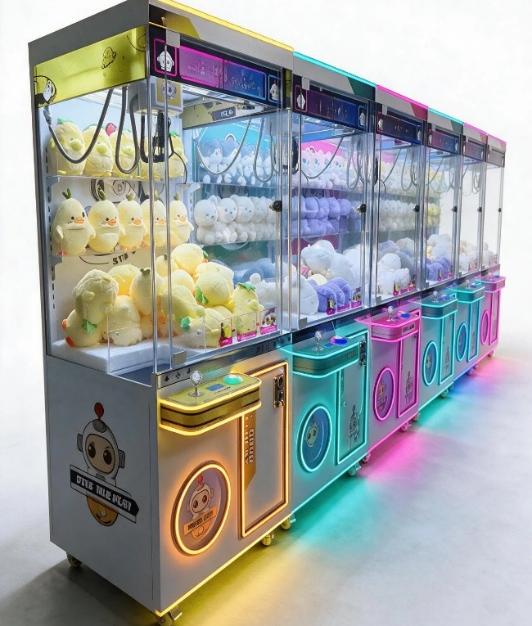
MOQ for Amusement Machines: How to Negotiate Minimum Order
Minimum order quantity stalls more first-time amusement equipment buyers than any other term in a quotation. A buyer sends a model list for six machines, gets a reply saying the minimum is twenty per model, and concludes the supplier is trying to move stock. Usually that is wrong: the buyer has misunderstood what the minimum is attached to.
This guide covers what an MOQ means in this industry, the four forms it takes, the six questions that reveal a real minimum, and how to build a mixed-model order that fills a container without hitting any of them.
What an MOQ really means in amusement equipment
The most important fact about MOQ here is that finished machines are almost always made to order. Nobody is holding 200 claw cranes in a warehouse waiting for your email. Production starts when your deposit clears, so the factory can usually build one machine as cheaply as it can build ten.
So where does a minimum come from? It comes from the parts bought in bulk before your order exists: claw assemblies, glass panels, control boards, LED light boxes, coin acceptors, artwork, crates and packaging cartons. A factory that buys 500 claws has to commit to 500 claws whether you take one machine or fifty.
MOQ in this industry is therefore usually a components and packaging commitment, not a restriction on finished goods.
That distinction matters because it is negotiable in ways a finished-goods MOQ is not. If your order includes twenty-four units of one cabinet and twelve of another, the factory buys components against thirty-six machines, and the buying plan becomes far more efficient than two separate small orders.
The four forms of MOQ you will be quoted
| MOQ type | What it actually binds | How hard it is to move |
|---|---|---|
| Finished-goods MOQ | A minimum number of complete units of one model before the factory starts a run | Hardest to reduce. Set by assembly line setup, not by parts supply |
| Same-model MOQ | Total units must reach a threshold, but may be split across models in the same category | Fairly flexible. Most suppliers accept this on request |
| Component MOQ | The minimum batch of a specific part, e.g. 500 claws, 300 coin acceptors | Rarely discussed openly, but the real number behind most quotes |
| Customisation MOQ | Branded artwork, custom cabinet colour, private-label control panel | Genuinely higher. Setup cost is real and usually quoted separately |
There is a fifth category buyers confuse with an MOQ: the minimum order value, expressed as a total invoice rather than a unit count. Ask whether a stated minimum is a unit count or a money figure, because they behave very differently.
The distinction that matters most in practice is between finished-goods MOQ and component MOQ. A finished-goods minimum of twenty units of one model means the factory cannot justify setting up the line for fewer. A component minimum of 500 claws is a purchasing decision made against a forecast, and your order changes that forecast if it is large enough.
Six questions to ask before you accept an MOQ
| Question | Why it matters | A good answer looks like |
|---|---|---|
| Can different models be combined to reach the minimum? | Decides whether a six-model order is workable | Yes, within the same category, with a list of which combinations are blocked |
| Can components be ordered separately, before the machine order? | Lets you build the machine bank in stages | Yes, with unit prices and a lead time for each lot |
| What is the MOQ on the customised elements specifically? | Branding is where MOQ quietly doubles | A stated number per element, reducible by paying a setup fee |
| Can a sample order ship on its own? | Removes the biggest single risk in an unproven relationship | Yes, and the sample cost is credited against the main order |
| Does the MOQ fall as order volume rises? | Lets a small first order open the relationship | A tiered table, e.g. 10 units at tier one, 30 at tier two |
| What is the MOQ on repeat restock orders? | Determines whether you can top up a model later | A lower figure than the first order, with a stated lead time |
If a supplier cannot answer the first question, that is the most important signal in the whole negotiation. A supplier who cannot mix models is telling you their minimum is driven by assembly-line economics rather than parts supply.
Mixed-model loading: how the numbers actually work
The container is the unit that matters, not the machine. Using published cabinet dimensions, a full-size claw crane at W78 x D85 x H190 cm occupies a floor footprint of about 0.66 square metres and, at 190 cm tall, is too tall to stack. From the internal dimensions of a 40HQ (12.03 m long, 2.35 m wide, 2.69 m high), that gives roughly 14 units along the length, 3 across the width and one layer high - a practical load of around 34 to 42 units per container.
The mini crane at W30 x D45 x H84 cm tells the opposite story. It stacks three high, so the same container holds several hundred of them on a packed pallet footprint. Same container, wildly different economics, and that is the whole argument for mixed loading.
The practical rule is simple: big cabinets anchor the floor, small machines fill the volume above and beside them. A full-size redemption game at W122 x D260 x H250 cm leaves a very different shadow than a 32-inch arcade cabinet at W82 x D60 x H155 cm, and the two complement each other well in the same container. A mixed container also solves the MOQ problem: if the minimum is 20 units of one model and you only need 8, mixing 8 cranes with 12 redemption units gets you past a components threshold without over-buying one product line.
When a sample order is worth the money
Samples are not a formality in this industry. A sample order and a pilot order are frequently the same order, and buyers who insist on a separate sample shipment often pay twice for the same factory work.
What should always go through a sample:
- Any machine with a custom control panel, custom artwork or a bespoke cabinet colour. Artwork problems are the most common reason a container is rejected on arrival, and they are visible in a photograph.
- Anything with an unusual mechanical function you have not seen running - a wave rider, a spinning redemption wheel, a race car seat assembly.
- Any machine where you are uncertain about the playing feel, such as a boxing or punching machine where the sensor calibration decides whether the game is fun.
What can usually go straight to bulk:
- Standard models from a catalogue, where the arcade video games range already specifies the cabinet, screen size and power rating.
- Repeat orders of a model you have already run successfully in a venue.
- Low-capital items such as the prize merchandisers, where the mechanism is simple and the failure cost of a mistake is low.
Ask directly whether a sample fee is credited against the main order. A supplier who treats the sample as a separate retail sale is telling you something about how the first bulk order will be handled.
Payment terms and how MOQ moves them
MOQ and payment terms are the same negotiation viewed from two sides. A large order gives the factory a reason to accept staged payment; a small one does not.
The normal structure for a first order is a deposit against the production start, a balance against shipping documents before dispatch, and sometimes a third point at inspection. Two things are worth pushing on: payment milestones tied to production evidence, and paying the balance against the bill of lading rather than against arrival. Paying on arrival means you have no leverage once the goods are on the water.
A buyer with no trading history will be asked for a larger deposit or full payment in advance. That is a rational response to risk, not a trick. The way to earn better terms is volume.
Signs that a MOQ is not real
A minimum that is soft usually has a tell:
- "Minimum 20 machines" with no explanation of why. Ask what the 20 is made of and the answer is usually components, which means the number is negotiable.
- The minimum is high, but the supplier will not say what the components are. If claws, coin acceptors and panels are bought in batches of 500, a 20-machine order does nothing to reduce the buying cost.
- Sample orders are exempt but bulk orders are not, with no tier table. If the factory is happy to build one, the constraint is not labour.
- The MOQ rises with customisation but the setup fee is not separated. A setup fee and a unit minimum are different instruments, and only one should be holding your order hostage.
None of this means the minimum is a lie. It means the number is a function of the factory's purchasing plan, and your order can be shaped to fit inside it.
The negotiation sequence
Step 1 - Inquiry
Send a model list with quantities, your target container type, destination port and country. Ask for a quotation with the MOQ stated separately for finished goods and for any custom elements.
Step 2 - Quotation review
Read the unit price, the MOQ, the lead time and the payment terms side by side. Confirm that the MOQ is expressed in units rather than value, and check whether it is per model or across the order.
Step 3 - MOQ negotiation
This is the step most buyers skip. Present the container target explicitly: "I want to fill one 40HQ." Then ask which combination of models reaches the minimum with the best mix for my venue. A supplier who can do the arithmetic on a container load will usually satisfy both sides, because filling a container is also good for them.
Step 4 - Sample
Order one or two units, or a sample of the most complex model only. Confirm the sample cost is credited, and that the sample unit is production-identical rather than a display unit.
Step 5 - Bulk order
Confirm the final model mix, the packing list, the container loading plan, the production start date and the document set. Our standard production lead time is 5-25 days for all models, so the schedule should be measured from the deposit and the signed specification, not from the day you first sent an email.
What to ask a supplier
Ask specifically: what is the MOQ per model, can models be combined, is there a tier table, what is the component MOQ behind the finished-goods figure, and what happens to the sample cost. Then ask one more question that reveals a lot: given the models I want, how would you fill a 40HQ? A supplier who answers with a real loading plan rather than a shrug will handle your repeat orders well.
We manufacture the full range - from claw and crane machines through redemption and ticket games to sports and skill games - in our own factory, so production starts against your order. Tell us the models, quantities, destination port and container type, and we will state the MOQ clearly in the quotation.
Tell us your venue type, floor area, target market and quantity, and our export team will propose a machine mix with confirmed pricing, MOQ and delivery timing.